March 1, 2026 | Updated May 11, 2026
AI in Production Is Very Different from AI in Demos
Production AI needs more than a strong model. It needs governance, observability, fallbacks, human oversight, and workflows that survive real complexity.
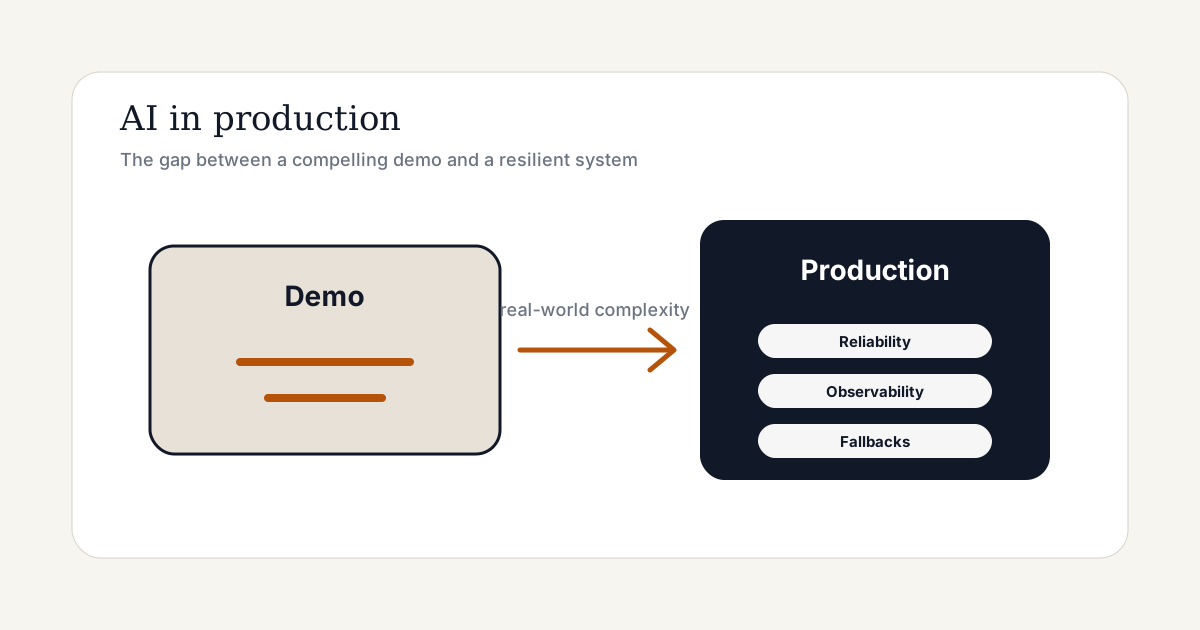
AI demos can be useful. They help teams imagine what is possible. But the real test of AI is not whether it works in a controlled walkthrough. The real test is whether it can operate inside messy enterprise systems, support real users, and earn enough trust to be used every day.
AI demos look impressive because they are usually built around the best possible version of the experience. The data is clean. The prompt is controlled. The scenario is narrow. The path is optimized to show what the model can do when everything goes right.
Production is different.
In production, the system has to work when the data is incomplete, the customer intent is unclear, the upstream API is slow, the policy is ambiguous, and the user is already frustrated. It has to work across regions, languages, devices, permissions, compliance rules, and operational constraints. It also has to fail gracefully when the model is uncertain or the system cannot complete the task.
That is where many AI initiatives struggle. The prototype proves that the model can generate an answer. The production system has to prove that the answer is useful, safe, reliable, explainable, and integrated into the workflow where the decision actually happens.
The hard part is rarely the first model call. The hard part is everything around it.
You need data pipelines that are trustworthy. You need retrieval systems that return the right context. You need guardrails that understand policy, not just keywords. You need evaluation frameworks that measure more than accuracy. You need observability that shows why something failed, where latency increased, and whether the customer outcome improved.
At scale, even a small failure rate becomes meaningful. A two percent error rate may sound acceptable in a demo. In a system serving millions of customers, that can become thousands of bad experiences, escalations, compliance risks, or manual recovery efforts.
This is why AI product work has to be treated as systems work.
A production AI system needs fallback paths. It needs human-in-the-loop review for high-risk decisions. It needs escalation logic. It needs auditability. It needs clear ownership between product, engineering, data, legal, security, and operations. Without that foundation, the model may be powerful, but the customer experience will still break.
This is why human-in-the-loop systems matter so much in enterprise AI. They are not a weakness in the architecture. They are part of what makes the system trustworthy.
The same pattern shows up in airline disruption recovery and real estate decision intelligence. The model is only one part of the product. The harder work is connecting prediction, policy, workflow, escalation, and accountability.
Trust is another major difference between demos and production. In a demo, people are often impressed by what the AI can do. In production, users quickly focus on whether they can rely on it. One wrong recommendation in a low-stakes workflow may be annoying. One wrong decision in travel, insurance, healthcare, finance, or enterprise operations can create real consequences.
That means production AI has to show its work. It should explain what data it used, what assumptions it made, what confidence it has, and when a human should review the outcome. Explainability is not just a technical feature. It is part of the trust model.
The teams that succeed with AI are usually not the ones chasing the flashiest demo. They are the ones building the operating system around the model. They think about lifecycle management, feedback loops, monitoring, governance, and continuous improvement from the beginning.
AI does not fail in production because models are bad.
It fails because systems are not designed for reality.
The real opportunity is to move beyond demos and build AI that can survive complexity, earn trust, and improve the workflows people depend on every day.
Frequently Asked Questions
Why do AI demos look better than production AI?
Demos usually use clean data, narrow scenarios, and controlled workflows. Production AI has to handle incomplete context, edge cases, latency, permissions, compliance rules, and users who may already be frustrated.
What makes AI production-ready?
Production-ready AI needs reliable data pipelines, retrieval quality, evaluations, observability, guardrails, escalation paths, human review for high-risk actions, and clear ownership across product, engineering, legal, security, and operations.
Why is human-in-the-loop important for enterprise AI?
Human-in-the-loop review gives the system a way to handle ambiguity, high-risk decisions, policy exceptions, and trust-sensitive workflows. It helps teams move faster without pretending every decision should be fully automated.
What should leaders measure beyond model accuracy?
Leaders should measure customer outcomes, task completion, escalation quality, latency, failure recovery, policy compliance, user trust, and whether the AI actually reduces operational burden.